

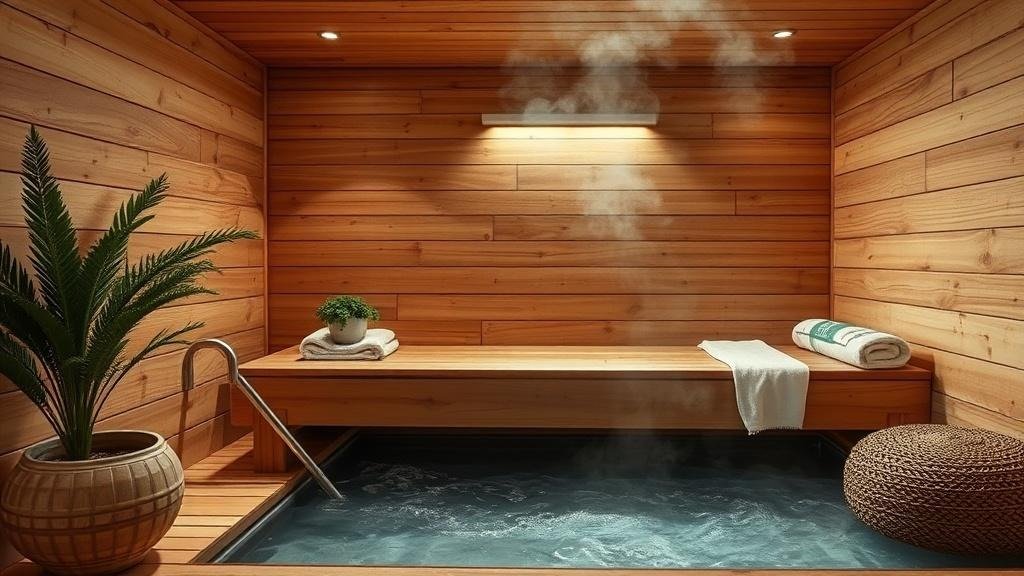
Home Sauna and Steam Room Guide for Indoor Setups is worth evaluating through the homeowner’s real week, not a perfect catalog photo. The best setup is the one that gets used, stays safe, and does not become a maintenance headache.
My neighbor Chris spent most of last October showing me pictures of barrel saunas on his phone. He’d just finished a bathroom remodel, had a leftover 240V run stubbed out in his garage, and figured adding a sauna to his backyard would be, in his words, “the easy part.” Three weeks later I watched him jackhammer out a settled gravel pad that had already shifted two inches under an 800-pound cedar barrel. He’d skipped the concrete. He’d guessed at the circuit amperage from a Reddit thread. The sauna itself was fine. Everything around it was wrong.
That story captures most home sauna and steam room projects in miniature. The unit is the fun part. The pad, the electrical, the ventilation, the permitting: that’s where builds succeed or fall apart. This guide covers all of it, with real numbers, relevant research, and the kind of install detail that keeps you from becoming a cautionary tale at the neighborhood block party.
Picking a Type (and Why the Marketing Makes This Harder Than It Should Be)
Infrared, traditional Finnish, steam room. Each gets marketed as though it renders the others obsolete, usually with cherry-picked physiology claims that wouldn’t survive peer review. The boring truth is that they’re different tools with different heat profiles, different electrical requirements, and different install footprints.
Traditional saunas run 170F to 195F, heat a cabin through convection (rocks plus a 4.5 to 9 kW electric heater or a wood-burning stove), and produce the dry-heat environment studied in most of the Finnish longitudinal research. Heat-up time is 25 to 45 minutes depending on cabin volume and insulation.
Infrared cabins operate at lower air temperatures (120F to 150F), warm the body more directly through radiant panels, and typically plug into a standard 120V outlet. They’re easier to install, cheaper to run, and produce a genuinely different physiological response. Whether that response is “better” or “worse” depends on what you’re optimizing for, and honestly, on personal preference.
Steam rooms need sealed surfaces, a dedicated steam generator (6 to 12 kW), proper drainage, and a vapor barrier that leaves zero room for shortcuts. They’re the most complex indoor install by a wide margin, and the most punishing if the waterproofing fails.
For a detailed side-by-side on specs, pricing, and warranty terms across all three categories, Sweat Decks’s infrared vs traditional vs steam guide is the reference I keep bookmarked and send to friends who ask.
What the Spec Sheet Actually Tells You (and What It Hides)
Spec sheets are where most buyers get tripped up. Here’s what matters.
Heater sizing. Match the heater to the cabin volume. Undersized heaters run constantly, shorten component life, and never quite hit target temperature on cold days. Oversized heaters cycle too aggressively and waste energy. Use the manufacturer’s published sizing chart. Forum wisdom is unreliable here.
Wood species and joinery. Pre-cut tongue-and-groove cladding in western red cedar, hemlock, thermo-aspen, or redwood is the standard for good reason. Cheap kits substitute butt joints with felt backing. Those builds leak heat at every seam and look weathered within two seasons. If the listing doesn’t specify tongue-and-groove, ask why.
Door hardware. Sounds trivial. It isn’t. A sauna door that doesn’t seal properly is a heater working overtime forever. Tempered glass doors with magnetic or roller catches hold up; friction-fit wood doors warp.
Cold-plunge specs (if you’re building a contrast setup). Check chiller HP, filtration micron rating, ozone/UV sanitation, and tub material. A 1/3 HP chiller holds 50F in a small insulated tub in a temperate climate. Put that same chiller in a Phoenix garage in August and it’ll run nonstop until something burns out.
The Research, Without the Hype
The most cited sauna research is the Laukkanen 2015 cohort published in JAMA Internal Medicine. It followed 2,315 middle-aged Finnish men for 20 years and found a dose-response relationship between sauna frequency and reduced cardiovascular mortality. Men using a sauna 4 to 7 times per week saw roughly half the cardiovascular mortality of those using it once per week. That’s a striking finding, though it comes with the usual observational-study caveats: these were Finnish men with decades of sauna culture baked into their lifestyles, not sedentary Americans trying it for the first time at 52.
A 2018 BMC Medicine follow-up from the same research group reported lower dementia incidence at the highest sauna frequencies. The plausible mechanism involves heat acclimation, improved endothelial function, and a heart-rate response that resembles moderate-intensity exercise.
For a home user, 20-minute sessions at 170F to 195F, two to four times per week, is a reasonable starting point. Hydrate before and after. Step out if you feel lightheaded. This isn’t a toughness contest.
Anyone with a cardiac history, uncontrolled blood pressure, or who is pregnant should talk to a physician before starting. Full stop.
See also: How to Spot a Good Crypto Project
Install: The Part Everyone Underestimates
A home sauna install is part carpentry, part electrical. Most adults with basic tool skills can assemble a pre-cut kit with a helper and a weekend. The electrical side is a completely different conversation.
The 240V question. A typical traditional sauna heater pulls 4.5 to 9 kW on a dedicated 240V circuit at 30 to 50 amps. That’s not something you splice into an existing run. A licensed electrician should size the breaker, run the circuit, pull the permit, and tie into your main panel. Cutting corners on high-amperage wiring is how house fires start. I realize that sounds dramatic. It isn’t.
Pad work comes first. A 4-inch compacted gravel pad with proper drainage is adequate for a barrel unit on flat, stable ground in a mild climate. A 4-inch reinforced concrete slab ($4 to $7 per square foot installed) is the right call for cabin saunas, wet climates, and freeze-thaw zones. Chris’s mistake was assuming gravel would stay put under weight. It won’t, not unless you compact it correctly and frame it with landscape timbers or a form.
Ventilation. Outdoor saunas need a fresh-air intake low, near the heater, and an adjustable exhaust high on the opposite wall. Indoor builds need a passive vent to the outside or a properly sized exhaust fan. Skip this and the air inside goes stale fast, which makes the experience genuinely unpleasant.
Permitting. Varies by jurisdiction. Many counties exempt detached structures under 200 square feet from building permits, but the electrical permit for a 240V circuit is almost always required separately. Call your local building department before ordering the kit. A five-minute phone call can save you a code-enforcement headache months later.
All-In Costs (Not Just the Sticker Price)
The unit price is only part of the number. Budget the pad, the wiring, permits, accessories, and a small maintenance reserve.
Saunas: Entry barrel kits start around $2,490. Mid-tier cabin saunas with quality heaters run $6,000 to $10,000. Premium builds with panoramic glass fronts or thermo-aspen cladding land at $12,000 to $16,980. Add $400 to $900 for a gravel pad, $1,200 to $2,400 for concrete, and $600 to $1,800 for the electrical run.
Cold plunges: A residential insulated tub with an integrated chiller runs $4,500 to $7,500. Commercial-grade stainless builds with full filtration hit $9,000 to $14,000. Stock-tank DIY setups come in at $400 to $900 but require manual ice, which gets old remarkably fast.
Appraisal value. Appraisers won’t add dollar-for-dollar return on a sauna. But a well-built outdoor wellness setup is increasingly treated as a selling feature in Northeast and Pacific Northwest markets, similar to how a quality deck or hot tub factors into buyer perception.
HSA/FSA eligibility. A residential sauna is rarely HSA or FSA eligible unless a clinician issues a Letter of Medical Necessity for a documented condition. Eligibility is patient-specific. Talk to your tax advisor before assuming a purchase will qualify.
My Honest Take on Where People Go Wrong
The two biggest mistakes I see are at opposite ends of the spectrum. Some buyers cheap out on everything, end up with a poorly insulated box on a shifting pad with undersized wiring, and abandon the whole thing within a year. Others over-build wildly, spending $18,000 on a premium cabin they use twice a month because they didn’t think about whether a sauna habit actually fits their routine.
The right answer (and I realize this sounds unsatisfying) is the build that matches your climate, your space, your electrical capacity, and the routine you’ll actually maintain. A $3,000 barrel sauna on a proper concrete pad with a clean electrical run, used four times a week, beats a $15,000 showpiece gathering dust every time.
FAQs
Can I install a home sauna on a deck?
Some smaller barrel units can sit on reinforced decks if the framing supports the loaded weight, typically 600 to 1,200 pounds. Most cabin units belong on a dedicated pad. Confirm load capacity with a structural engineer or your contractor before placing any unit on existing decking.
How often does a home sauna need maintenance?
Wipe down benches after each session and oil exterior cedar or hemlock once a year. For cold plunges, replace filter cartridges every 6 to 12 weeks, run ozone or UV sanitation on schedule, and drain and refill per the manufacturer’s recommended interval.
Will my electric bill spike?
A 6 kW sauna heater running one hour costs roughly $0.60 to $1.20 at typical US residential rates. Three 20-minute sessions per week add about $4 to $8 per month. A 1/2 HP cold-plunge chiller in steady state pulls about 350 to 450 watts and adds $8 to $15 monthly in most climates.
Is sauna use safe during pregnancy?
Pregnant adults should not start a new sauna or cold-plunge routine without explicit clearance from their OB-GYN. Core temperature changes carry real fetal risks, particularly in early pregnancy. Defer to your physician on this one without exception.
How loud is a cold-plunge chiller?
A traditional sauna heater is silent in operation. A cold-plunge chiller runs at roughly 45 to 55 dB at one meter, comparable to a quiet conversation. Place the unit where the chiller hum won’t bother neighbors or adjacent bedrooms.
Disclaimer. This article is general consumer information, not medical advice. Heat and cold therapies carry real cardiovascular load. Anyone with arrhythmias, uncontrolled hypertension, Raynaud’s phenomenon, recent cardiac events, or who is pregnant should consult a physician before starting any new sauna or cold-plunge routine.
Any 240V electrical work should be completed by a licensed electrician under the appropriate local permit.
HSA and FSA reimbursement on wellness equipment is patient-specific and depends on a Letter of Medical Necessity from a clinician. Talk to your tax advisor before assuming a purchase qualifies.
